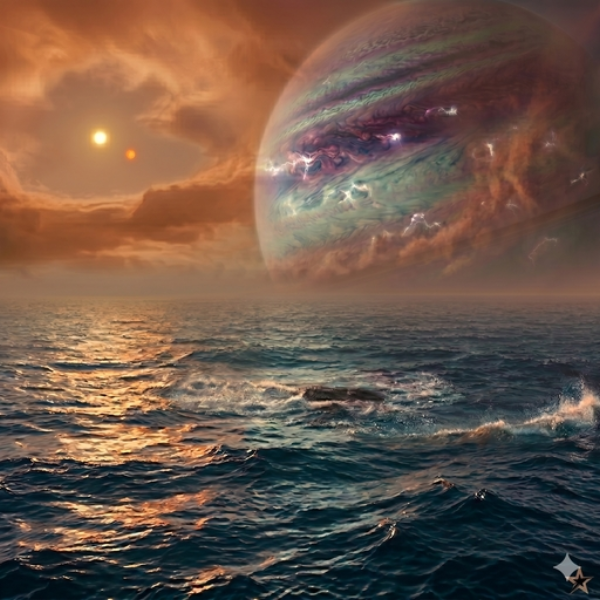

Planet Size: Roughly \(4.7\) times the radius of Earth, making it similar to Neptune in size.Orbital Period: Orbits the binary stars every \(303.2\) days.Eccentricity: Somewhat eccentric but fits squarely in the conservative habitable zone, with a measured eccentricity of \(<0.41\) (specifically estimated as low). Habitability: This planet is the most famous because it sits squarely within the system's conservative habitable zone. However, because it is a gas giant, it lacks a solid surface Exomoons: Astronomers suspect that the planets in this system—especially the gas giants in the habitable zone—could host exomoons.Stability: A major requirement for an exomoon is that its distance to its parent planet must be well within the planet's gravitational zone (Hill sphere) so the pull from the binary stars does not tear it away.Habitability: If a sufficiently large, rocky moon orbits Kepler-47 (AB) c, it could potentially support an atmosphere and liquid water on its surface, making it an intriguing place to search for extraterrestrial life. Nice for beach-like environment One of my favorites

0:00 /
0:00
Pad 81 Starts: Echo 2 Starts: Pad 31 starts: